Carrying an inherited vacant home typically runs several thousand dollars per month before any major repairs surface. That range covers property taxes, insurance, utilities, lawn care, and basic security. The actual number depends on location, home size, and condition, but almost every heir underestimates it until the first few bills arrive.
Before you do anything else, take these four steps in week one:
- Secure the property. Change or rekey all locks, board any broken windows, and do a walk-through to document the home’s condition with dated photos and video.
- Notify the insurer immediately. Standard homeowner policies often restrict or void coverage after just 30–60 days of vacancy, per probate guidance from ProbatePedia. Ask about a vacancy endorsement or a standalone vacant-home policy.
- Open an estate bank account. All property expenses must flow through the estate, not your personal finances. If the estate lacks liquidity, document that gap in writing now.
- Photograph everything. Condition documentation protects the executor from liability and establishes a baseline for insurance claims, contractor estimates, and eventual sale pricing.
The CNBC analysis on inherited homes makes the cost of delay concrete: emotional attachment and indecision routinely add tens of thousands in yearly carrying costs and accelerate property value decline. A clear decision deadline, typically six months, is the single most effective way to stop that drain.
Key Takeaways
Carrying an inherited vacant home typically costs $1,500–$4,000 per month, and a six-month decision deadline is the most effective way to prevent those costs from compounding into a serious financial loss.
| Point | Details |
|---|---|
| Monthly carrying costs | Expect $1,500–$4,000/month in typical carrying costs before major repairs surface. |
| Six-month rule | Set a firm decision deadline of six months from the date of death to prevent compounding costs. |
| Executor’s duty | Executors must use estate funds, not personal money, and document every expense to avoid personal liability. |
| Stepped-up basis | The IRS adjusts your cost basis to fair market value at death, which can reduce capital gains on a timely sale. |
| Housegoodbye option | Housegoodbye connects Michigan heirs with competing cash offers to sell as-is and close in as little as 7 days. |
Table of Contents
- What are the real costs of maintaining an inherited vacant home?
- What vacancy-specific risks can drive your costs higher?
- What maintenance and repair costs should you expect?
- Who pays during probate and what are the executor’s duties?
- What are the tax implications when you inherit and later sell?
- How do you decide whether to keep, rent, or sell?
- Your two-week and two-month action checklist
- How does a cash/as-is sale platform work for inherited homes?
- What executors actually face when managing an inherited home
- Stop carrying costs fast with Housegoodbye’s cash-offer marketplace
- Sources
- FAQ
What are the real costs of maintaining an inherited vacant home?
Every vacant inherited home carries a stack of recurring expenses that continue whether anyone lives there or not. The article provides a table with estimated ranges for monthly and annual costs for various expense categories, such as property taxes, vacant-home insurance, utilities, lawn care, and others, varying by property type and condition. It illustrates that these costs can be significant but vary widely.

Property taxes vary dramatically by state and county. The Tax Foundation’s state and county property-tax data is the fastest way to check your jurisdiction’s effective rate before you build a budget.
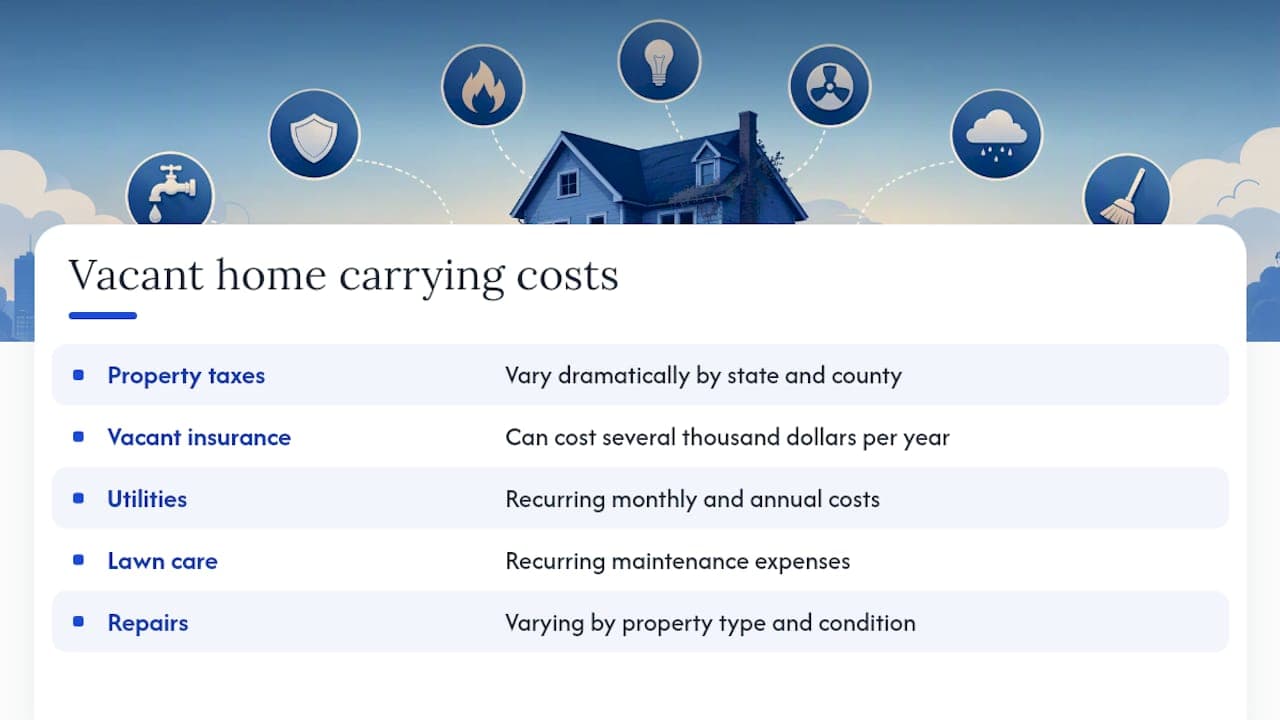
Insurance deserves special attention. A standard homeowner policy was written for an occupied home. Once a property sits vacant, MoneyGeek’s vacant-home insurance guidance explains that underwriters factor in vacancy length, property condition, and security measures, and vacant-home policies typically cost materially more than standard coverage. Vacant home insurance can cost several thousand dollars per year depending on the property’s value, location, and condition.
Which costs are estate expenses vs. personal?
During probate, the estate pays all carrying costs. The executor draws from estate funds, not personal accounts. Once the estate closes and heirs take title, those costs become the heirs’ personal responsibility. If the estate lacks cash to cover ongoing expenses, the executor should document the shortfall and consult the probate court or estate attorney about options, including an early sale.
What vacancy-specific risks can drive your costs higher?
A vacant home is not just an occupied home with the lights off. It is a different risk profile entirely, and the costs that come with it can appear suddenly and run large.
The most common vacancy-driven exposures:
- Insurance gaps or policy cancellation. Most standard homeowner policies limit or exclude coverage after 30–60 days of vacancy. A lapse means any loss, fire, vandalism, or water damage, comes entirely out of the estate.
- Vandalism and theft. Vacant homes are targets. Copper pipe theft alone can cost $3,000–$10,000 in repairs once water damage is factored in.
- Squatters. Removal requires a formal eviction process in most states, which takes weeks and costs legal fees.
- Pest infestations. Rodents and insects move into undisturbed spaces quickly. A full termite treatment can run $1,500–$3,000; severe rodent remediation is comparable.
- Freeze and burst pipes. A single burst pipe event can cause $5,000–$70,000 in water damage depending on how long it goes undetected. Winterization, which costs roughly $100–$300 for a standard home, is one of the highest-return preventive expenses you can make.
- Landscaping fines and HOA penalties. Many municipalities and HOAs issue fines for overgrown lawns or unmaintained exteriors. These accumulate fast and can become liens on the property.
- Boarding and emergency tarping. If a window breaks or a roof section fails, emergency boarding runs $200–$600 per opening; emergency roof tarping typically costs $300–$1,500 depending on size.
Insurance underwriters watch for visible signs of neglect, overgrown yards, clogged gutters, and broken fixtures, when deciding whether to issue or renew a vacant policy. Regular exterior maintenance and a monitored alarm system improve your odds of obtaining coverage and can reduce premiums.
Pro Tip: A bi-weekly exterior check by a neighbor, property manager, or local handyman costs very little and signals to both insurers and potential vandals that the property is actively monitored. Some insurance carriers will reduce premiums or maintain coverage when you can document regular inspections.
What maintenance and repair costs should you expect?
There is a meaningful difference between recurring maintenance and deferred capital repairs, and confusing the two is how estates end up with a $40,000 surprise six months in.
Recurring maintenance covers the work that keeps a vacant home from deteriorating: HVAC filter changes, minor plumbing checks, gutter cleaning, and exterior touch-ups. These costs are modest individually, typically $50–$300 per visit, but they prevent the larger failures.
Deferred and major repairs are a different category. These are the costs that accumulate when a home has been neglected, sometimes for years before the owner passed. Common examples and rough ranges:
- Roof replacement: $8,000–$25,000 depending on size and material
- HVAC system replacement: $5,000–$12,000
- Water heater replacement: $1,000–$3,500
- Foundation crack repair: $2,000–$15,000+
- Electrical panel upgrade: $1,500–$4,000
- Full interior cleanout and junk removal: $1,000–$5,000
The escalation dynamic is worth understanding clearly. A $500 roof repair left unaddressed for one season can become a $3,000 repair. Left another season, it can trigger interior water damage that costs $15,000–$30,000 to remediate. Deferred care does not just delay costs; it multiplies them. Costly repairs that kill home deals illustrates how deferred maintenance erodes sale proceeds in ways heirs rarely anticipate.
When to get contractor quotes:
- Within the first two weeks, walk the property with a checklist and note anything that looks actively deteriorating: roof staining, soft floors, water marks on ceilings, HVAC that won’t turn on.
- Get at least two contractor estimates for any repair over $1,000. Written estimates become part of the estate’s accounting record.
- If the home is older than 30 years, schedule a licensed home inspector before making any major decisions. A $400–$600 inspection report gives you a defensible repair priority list and protects the executor from claims of negligence.
Document every estimate, receipt, and inspection report. That paper trail matters at probate review and at sale.
Who pays during probate and what are the executor’s duties?
The executor, sometimes called a personal representative, has a fiduciary duty to preserve estate assets. That duty starts the moment they take on the role, not when probate formally closes. AllLaw’s executor guidance is direct on this point: executors must use estate funds to pay property expenses, and failure to maintain or insure a vacant property can create personal liability.
That means the executor should never pay carrying costs from personal funds unless they intend to seek reimbursement through the estate, documented carefully. If the estate account runs low, the executor’s job is to flag that to the probate court and co-heirs, not to quietly absorb the costs.
Recordkeeping checklist for executors:
- All receipts for property expenses (taxes, insurance, utilities, repairs)
- Dated inspection logs and condition photos
- Insurance policy documents and any correspondence about vacancy endorsements or policy changes
- Bank statements showing estate account activity
- Written contractor estimates and invoices
- Any HOA correspondence or municipal notices
State probate rules vary on timelines and required filings. The National Conference of State Legislatures tracks state-level variations in probate procedures that affect both timing and estate expenses. For Michigan-specific executor duties and probate timing, Housegoodbye’s probate guide for Michigan covers the process in practical terms.
If possession of the property is disputed, for example when multiple heirs disagree about access or control, the executor can seek a court order. State-level guidance, such as North Carolina’s executor guidance from Pierce Law, makes clear that securing the property and seeking court authority when needed are both within the executor’s duties and protections.
For executors managing multiple properties or complex estates, the estate administration steps checklist from Simons George Legal provides a structured walkthrough of the full administration process.
What are the tax implications when you inherit and later sell?
Property taxes, federal income taxes, and eventual sale costs all interact in ways that can significantly change the net value of holding versus selling.
Property taxes continue to accrue regardless of occupancy. Some states reassess property values at death, which can push annual taxes higher. Check your county assessor’s website for the current assessed value and any pending reassessment. The Tax Foundation’s property-tax data by state and county gives a useful starting benchmark for estimating your annual tax burden.
Federal tax basics: the stepped-up basis
When you inherit a home, the IRS generally adjusts your cost basis to the fair market value of the property on the date of death. This is called a stepped-up basis. IRS Topic No. 701 covers the rules in detail. The practical effect: if you sell the home relatively soon after inheriting it at or near its current market value, your taxable capital gain may be minimal. If you hold the property for years while it appreciates, that gap between your stepped-up basis and the eventual sale price becomes taxable.
If you rent the property, rental income is taxable, but you can deduct maintenance expenses, insurance, property taxes, and depreciation. Keep every receipt.
Selling costs to budget:
The math on a traditional sale often looks better on paper until you factor in the carrying costs during a 90-day listing period and the repair costs needed to list competitively. For estates with deferred maintenance, the gap between a traditional sale net and a cash-as-is offer frequently narrows to a few thousand dollars, sometimes less.
How do you decide whether to keep, rent, or sell?
The six-month rule is a practical estate-management principle: set a firm decision deadline of six months from the date of death. CNBC’s reporting on inherited homes supports this directly, noting that delayed decisions and emotional attachment routinely produce hidden carrying costs and accelerate property value decline. Six months is enough time to complete probate basics, get contractor estimates, and assess the rental market, without letting carrying costs compound indefinitely.
Step-by-step decision checklist:
- Calculate your monthly carrying-cost gap. Add up all line items from the cost table above. That is your monthly burn rate.
- Assess estate liquidity. Can the estate fund 6–12 months of carrying costs without selling assets? If not, a fast sale becomes a fiduciary priority, not just a preference.
- Get a repair estimate. A licensed inspector’s report tells you whether the home needs $5,000 or $50,000 before it can rent or sell competitively.
- Research local rental rates. Check current rental listings in the neighborhood. If gross rent minus expenses (management fees, maintenance, vacancy allowance) does not exceed your carrying costs by a meaningful margin, renting is not a financial win.
- Check local market conditions. A seller’s market favors listing; a slow market may favor a cash-as-is sale to avoid months of carrying costs during a long listing period.
- Account for family dynamics. If multiple heirs disagree, delay is expensive. Tips for dividing inherited property between siblings from Simons George Legal covers negotiation strategies that can accelerate a decision.
Breakeven example:
Assume a mid-market home with $1,500/month in carrying costs and an estimated $15,000 in repairs needed to rent competitively. Gross rent potential is $1,800/month. That is $300/month below carrying costs before the $15,000 repair investment is recovered. At that rate, the repair investment alone takes over four years to break even, not counting ongoing landlord obligations.
A cash-as-is offer on the same home might come in $20,000–$30,000 below a repaired retail value, but it closes in days, eliminates the repair cost entirely, and stops the $1,500/month carrying-cost drain immediately.
Pro Tip: If you are past the three-month mark with no firm decision, treat that as a signal to accelerate. Every additional month of indecision is a month of carrying costs with no return. Set a calendar deadline and commit to it.
Your two-week and two-month action checklist
Speed matters. The first two weeks set the trajectory for everything that follows.
Two-week checklist:
- Change or rekey all locks, including garage and outbuildings
- Conduct a full walk-through; photograph and video every room and the exterior
- Notify the insurer and request a vacancy endorsement or new vacant-home policy
- Notify the mortgage servicer if there is an outstanding loan
- Forward or stop mail delivery
- Arrange initial lawn mowing or snow removal as needed
- Install at least one exterior security camera or motion-activated light
- Open an estate bank account if not already done
Two-month checklist:
- Schedule a licensed home inspection and obtain a written report
- Arrange winterization if the season requires it (drain pipes, shut off water, set minimal heat)
- Obtain at least two written contractor estimates for any critical repairs identified in the inspection
- Review insurance coverage and confirm the vacancy endorsement is active
- Research local rental rates and consult a property manager about realistic net income
- Consult the estate attorney about probate timeline and whether an early sale is permissible
- Set a firm decision deadline, no later than six months from the date of death
Pro Tip: If you live out of state or cannot manage the property personally, hire a local property manager for a short-term engagement, typically month-to-month. They handle vendor coordination, inspections, and emergency response for a flat monthly fee, usually $100–$200 for a vacant property. That cost is an estate expense and far cheaper than a missed maintenance issue.
How does a cash/as-is sale platform work for inherited homes?
A cash/as-is marketplace connects homeowners directly with local real estate investors who compete to buy the property in its current condition. The homeowner submits basic property details, receives multiple offers, compares them, and chooses whether to accept. No repairs, no staging, no agent commissions, and no open houses.
The core advantages for an inherited estate:
- No repair costs. Investors buy as-is, so the $15,000–$50,000 in deferred repairs that would be required for a traditional listing stay off the table.
- No agent commissions. A traditional sale at 5%–6% commission on a $250,000 home costs $12,500–$15,000 before closing costs. A cash sale eliminates that line item.
- Fast closing. Closings can happen in as little as 7 days, which stops the monthly carrying-cost drain immediately.
- Competing offers. Multiple investors bidding on the same property creates price competition that a single off-market offer does not.
Carry vs. cash-as-is: a cost comparison example
Assume a $250,000 home with $1,800/month in carrying costs, $20,000 in deferred repairs needed to list traditionally, and a 90-day listing period.
The cash-as-is scenario often nets more because it eliminates the repair cost, the commission, and three months of carrying costs. The exact outcome depends on the offer received, but the comparison is worth running with real numbers before assuming a traditional listing is the better path.
For heirs who want to sell an inherited house in Michigan as-is, the process works the same way: submit the property, receive competing offers, and close on a timeline that works for the estate.
What executors actually face when managing an inherited home
Most guides treat inherited-home decisions as purely financial. The reality is messier. Executors are often grieving family members who also happen to be legally responsible for a property they may have never managed, in a market they may not know, while navigating disagreements with co-heirs.
The fiduciary duty is real and it has teeth. An executor who lets insurance lapse, defers a repair that causes further damage, or fails to document expenses can face personal liability claims from other heirs. That is not a theoretical risk; it is a documented pattern in estate litigation.

What actually helps is treating the inherited home like a business problem from day one: assign a monthly cost, set a decision deadline, document everything, and resist the pull to delay because the decision feels emotionally difficult. The six-month rule exists precisely because most heirs need a forcing function. Without a deadline, carrying costs accumulate quietly until they become impossible to ignore.
The rest of this guide is designed to give executors and heirs the documentation framework and cost clarity to make a defensible, well-timed decision, whatever that decision turns out to be.
Stop carrying costs fast with Housegoodbye’s cash-offer marketplace
Carrying costs on an inherited vacant home compound every month you wait. Housegoodbye gives Michigan heirs a faster exit: submit your property details, receive competing cash offers from vetted local investors, and close in as little as 7 days, with no repairs, no agent commissions, and no listing required.

The platform is built specifically for situations like this. Estate with deferred maintenance? Investors buy as-is. Probate timeline creating pressure? A 7-day close fits. Multiple heirs who need a clean, documented transaction? Competing offers create a transparent, defensible outcome for everyone at the table.
Compare real cash offers for your inherited home and see what local investors will pay, with no obligation to accept. If you want to understand the full process first, how selling your house for cash works walks through every step. You can also sell your house as-is in Michigan without making a single repair.
Sources
Official and authoritative references used in this article:
- Inherited home: sell, rent, or keep? — CNBC
- Managing estate property during probate — ProbatePedia
- Topic No. 701 - Basis of property — IRS
- Property taxes by state and county — Tax Foundation
State rules on probate, property taxes, and executor authority vary. Check your county tax assessor’s website and your state’s probate court for jurisdiction-specific requirements. This article provides general information, not legal or tax advice. Consult a qualified estate attorney or tax professional for guidance specific to your situation.
This article is general information, not a substitute for advice from a qualified financial advisor. Consult a qualified financial professional about your own circumstances before acting on anything here.
FAQ
What is the two-year rule for inherited property?
The two-year rule is not a federal standard but refers to a common state-level capital gains exclusion: some states allow heirs to sell an inherited primary residence within two years and qualify for favorable tax treatment. Federal rules focus on the stepped-up basis at death; consult IRS Topic No. 701 and a tax professional for your specific situation.
What fees do you pay when you inherit a house?
During probate, the estate typically pays property taxes, insurance, utilities, and maintenance. Once you take title, those costs become yours personally.
How do you avoid paying taxes on an inherited home?
Selling the property close to its date-of-death value minimizes capital gains because the stepped-up basis resets your cost basis to fair market value at death. The longer you hold and the more the property appreciates, the larger the potential taxable gain. A timely sale, especially a cash-as-is sale shortly after inheriting, often produces little to no federal capital gains tax.
How do you clean out a house you inherited?
Start with a full inventory before removing anything, as some items may have estate value. Hire a licensed estate sale company for valuables, then a junk removal service for the remainder. Full cleanouts typically cost $1,000–$5,000 depending on volume. If you are selling as-is through a cash-offer platform, many investors will accept the property with contents, eliminating the cleanout cost entirely.