The Role of Competing Cash Offers in Home Sales

TL;DR:
- Multiple cash offers boost sellers’ negotiating power by encouraging competition and better terms.
- Buyers sharpen their bids when aware of other investors, reducing demands and contingency requests.
Competing cash offers are multiple simultaneous bids from cash buyers, giving homeowners direct negotiating power over price, terms, and closing timelines. Most sellers accept the first offer they receive without realizing they are leaving money and flexibility on the table. The role of competing cash offers is to shift that dynamic entirely. Instead of reacting to a single buyer’s terms, you control the conversation. Housegoodbye is built on exactly this principle, bringing multiple verified investors to bid on your property so you walk away with the best possible outcome.
How competing cash offers shift negotiating power to homeowners
Multiple qualified cash offers shift leverage to the homeowner, enabling negotiations on price, terms, and closing dates. That shift matters because a seller with one offer has no choice but to accept, counter, or walk away empty-handed. A seller with three competing offers holds a completely different position.

The mechanics are straightforward. When buyers know other investors are bidding, they sharpen their numbers and reduce demands. Contingencies shrink. Timelines tighten. Buyers who might otherwise ask for repairs or credits stop making those requests because they know another buyer will not.
Competing cash offers often lead to improved contract terms such as occupancy flexibility, closing timelines, and reduced contingencies. That means you can negotiate a leaseback period if you need extra time to move, or push for a seven-day close if you need cash fast. Price is only one dimension of a good deal.
- Closing date control: You set the timeline that works for your situation, not the buyer’s.
- Occupancy flexibility: Competing buyers often agree to leaseback arrangements to win the deal.
- Fewer contingencies: Buyers drop inspection and financing demands when they face real competition.
- Repair credits eliminated: No buyer will ask for a $10,000 repair credit when another buyer is ready to close as-is.
Pro Tip: Request best-and-final offers from all competing buyers by a set deadline. This single tactic prevents buyers from lowballing and forces every party to put their strongest offer forward at once.
Why the highest offer isn’t always the best
The headline offer price is a poor metric; net proceeds accounting for risks like appraisal and financing failure determine true value. A $320,000 financed offer that falls through after 45 days costs you more than a clean $295,000 cash offer that closes in seven days. The math includes carrying costs, re-listing fees, and the time value of money.
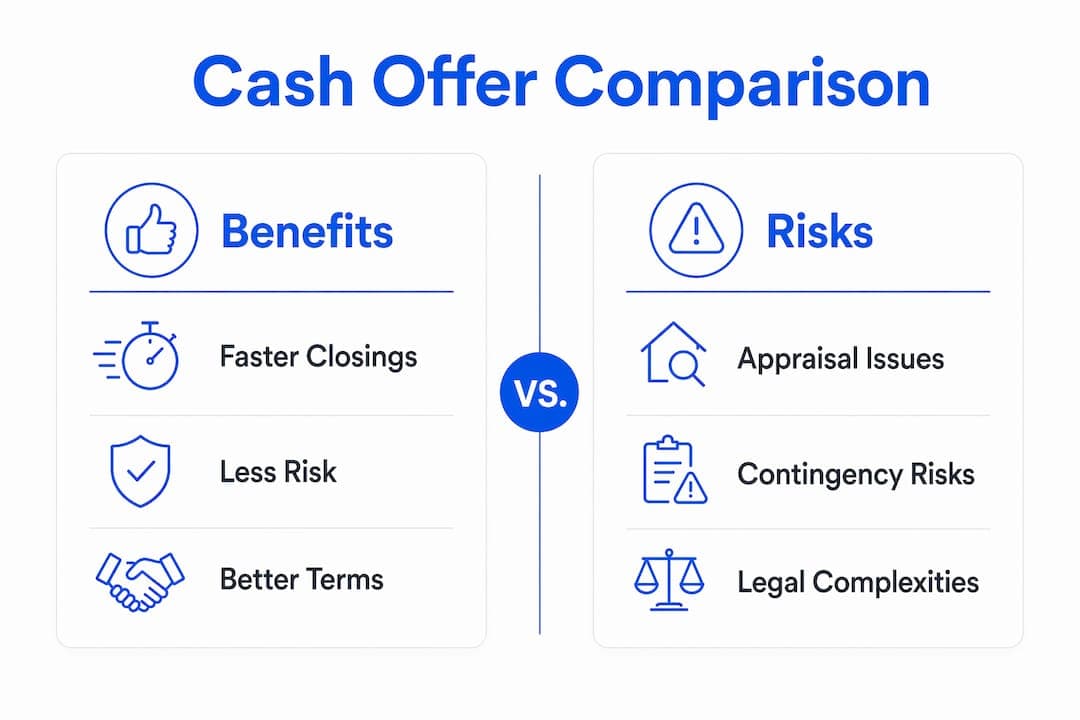
Cash buyers typically eliminate appraisal and financing contingencies, offering faster, more certain closings. That certainty has real dollar value. Every month a home sits under a failed contract costs the seller in mortgage payments, taxes, insurance, and maintenance.
| Offer type | Appraisal risk | Financing risk | Typical closing time | Net proceeds reliability |
|---|---|---|---|---|
| Financed offer, high price | High | High | 30–60 days | Moderate |
| Cash offer, no contingencies | None | None | 7–14 days | High |
| Cash offer with inspection contingency | None | None | 14–21 days | High |
| Financed offer with appraisal gap coverage | Moderate | High | 30–45 days | Moderate |
Verified cash offers with proof of funds dated within 30 days and no contingencies are safer and often more profitable than higher, riskier offers. A buyer who cannot produce a bank statement on request is a buyer who may not close.
- Confirm proof of funds is a bank statement, not a letter from a financial advisor.
- Check that the statement is dated within the last 30 days.
- Confirm whether the buyer needs to liquidate assets to fund the purchase, which adds timeline risk.
- Read every contingency carefully. A waived inspection contingency means the buyer cannot exit after inspection findings, not that they skip the inspection entirely.
Pro Tip: Ask your real estate attorney to review contingency language before you accept any offer. A single clause can turn a “clean” cash offer into a deal that falls apart at the last minute.
Understanding how selling your house for cash works gives you a clear framework for comparing these risk factors before you sign anything.
What are the most common pitfalls when comparing competing cash offers?
Anchoring bias is the single biggest mistake sellers make. Anchoring bias leads sellers to fixate mentally on the highest offer, ignoring the risk of failure and hidden costs if that deal collapses. Once you see a $340,000 number, every other offer feels like a loss, even if the $340,000 deal has a 40% chance of falling through.
Sellers often underestimate the ongoing costs and emotional toll if a higher offer collapses and the home must be re-listed. Re-listing resets your negotiating position, signals distress to new buyers, and often results in a lower final sale price than the second-best offer you originally passed on.
- Skipping proof of funds verification. Never accept an offer without a bank statement dated within 30 days. A letter of intent without verified funds is not a cash offer.
- Ignoring contingency language. Read every contingency clause. Waiving an inspection contingency is not the same as waiving the right to inspect. Understand exactly what each clause permits the buyer to do.
- Anchoring on the highest number. Calculate net proceeds for each offer after accounting for closing timeline, contingency risk, and any seller concessions. The highest gross number rarely produces the highest net.
- Accepting verbal commitments. Every term must appear in writing. Verbal promises about closing dates or repair credits are unenforceable.
- Failing to set a deadline. Without a response deadline, buyers have no urgency. Set a 24–48 hour window for best-and-final offers to keep competition alive.
Competing cash offers provide confidence by giving sellers options and a clearer understanding of market value and buyer priorities. That confidence disappears the moment you accept a single offer without comparison.
How can sellers use competing cash offers to meet their goals quickly?
Sellers who generate multiple bids before accepting any offer consistently outperform those who accept the first reasonable number. The process does not require a traditional listing or months on the market. Platforms like Housegoodbye bring verified investors to you, creating competition without the delays of a conventional sale.
Competing cash offers move sellers from defensive positions accepting single bids to empowered negotiators commanding better prices and terms. That shift in psychology changes everything about how you approach the transaction.
- Solicit at least three offers before deciding. One offer tells you nothing about market value. Three offers tell you exactly where the market sits and which buyer is most serious.
- Negotiate terms alongside price. Use competing bids to push for your preferred closing date, a leaseback period, or an as-is sale with no repair credits.
- Consider no-obligation cash offers. A no-obligation cash offer is a written bid you can review, compare, and decline without penalty. It costs you nothing and gives you a real data point on your home’s value.
- Balance speed and price deliberately. If you need to close in seven days, prioritize the cleanest offer over the highest one. If you have flexibility, use the timeline to let competition build.
- Use the bidding process as market research. The spread between your lowest and highest offer reveals how buyers perceive your property’s condition, location, and value.
For sellers navigating negotiation strategies with real estate investors, understanding buyer psychology is as valuable as knowing your home’s market value. Buyers who move fast and waive contingencies are signaling strong motivation. Use that signal.
The impact of cash offers on final sale prices is most visible when sellers create genuine competition. A single investor knows you have no alternative. Three investors know they must compete or lose the deal.
Key Takeaways
Competing cash offers give sellers the leverage to negotiate better prices, cleaner terms, and faster closings than any single offer can deliver.
| Point | Details |
|---|---|
| Competition creates leverage | Multiple cash bids shift negotiating power to the seller, improving both price and terms. |
| Net proceeds beat headline price | A lower, verified cash offer often delivers more money than a higher, riskier financed bid. |
| Verify funds before accepting | Require bank statements dated within 30 days to confirm every buyer’s ability to close. |
| Avoid anchoring bias | Calculate risk-adjusted net proceeds for each offer instead of fixating on the highest number. |
| No-obligation offers cost nothing | Collecting multiple written cash offers gives you real market data with zero commitment. |
What I’ve learned about sellers who skip the comparison step
I have watched sellers accept the first cash offer they receive and feel relieved, only to realize weeks later that a second buyer would have paid more and closed faster. The relief is real. The cost is also real.
The sellers who do best are not the ones who hold out for the highest number. They are the ones who understand what they actually need from the sale. Some need speed above everything else. Others need a specific closing date tied to a school year or a job start. Competing offers give you the information to match the right buyer to your real priorities, not just your financial ones.
What surprises most sellers is how much the bidding process itself changes buyer behavior. A buyer who opens at $270,000 will often move to $290,000 when they learn another investor is in the conversation. That $20,000 difference did not require a counteroffer. It required competition.
The market in 2026 still rewards sellers who create that competition deliberately. Waiting for the market to do it for you is a passive strategy that leaves money and control on the table. The sellers who win are the ones who treat their home sale like a structured process, not a one-time transaction with whoever shows up first.
— Bryan
Sell faster and smarter with Housegoodbye
Housegoodbye brings multiple verified cash investors to bid on your home, so you never have to accept the first offer you receive. The platform handles the entire process: no repairs, no agent fees, and no obligation to accept any offer you receive.

Sellers who use Housegoodbye’s cash offer comparison platform get real, written bids from competing buyers within days. Housegoodbye guarantees closing in as little as seven days for sellers who need speed. You can also sell your home as-is without making a single repair, regardless of your property’s condition. The process is built for homeowners who want certainty, not guesswork about whether a buyer will actually close.
FAQ
What is a no-obligation cash offer?
A no-obligation cash offer is a written bid from a buyer that you can review and decline without any penalty or commitment. It gives you a real data point on your home’s value with zero risk.
How do competing cash offers benefit sellers financially?
Multiple competing cash offers push buyers to sharpen their bids and reduce contingencies, which increases both the sale price and the reliability of closing. Sellers with three or more offers consistently negotiate better terms than those who accept a single bid.
What does “as-is” mean in a cash home sale?
An as-is cash sale means the buyer purchases the property in its current condition with no repairs required from the seller. Cash buyers typically waive repair demands because they price the property’s condition into their offer upfront.
How do I verify that a cash offer is real?
Request a bank statement dated within the last 30 days showing sufficient funds to cover the purchase price. A letter from a financial advisor or a pre-approval letter is not proof of cash.
How quickly can I close with a cash buyer?
Cash buyers eliminate appraisal and financing contingencies, which removes the main delays in a traditional sale. Closings with verified cash buyers typically happen within 7–14 days of accepting an offer.