
Selling your home without spending a dollar on staging, repairs, or cleaning is exactly what a cash offer with no staging costs delivers. You get an all-cash bid from an investor or house-buying company, accept it, and close, often in as little as 7 days, without touching a paintbrush or hiring a stager. The trade-off is real: these offers typically land between 50% and 90% of your home’s market value. What you give up in price, you get back in speed, certainty, and zero prep costs.
Here is what defines this type of sale:
- No repairs or renovations required. The buyer takes the property as-is.
- No staging, cleaning, or professional photography. You skip all the prep work traditional listings demand.
- No agent commissions. Most cash buyers deal directly with sellers.
- No upfront fees. Sellers pay nothing out of pocket before closing.
- Fast closing. Deals typically close in 7–21 days after offer acceptance.
Cash buyers in this space are usually real estate investors, house-flipping companies, or institutional buyers who plan to renovate and resell. Their motivation is profit, which is why the offer price reflects renovation costs they expect to absorb.
How the no-staging cash offer process actually works
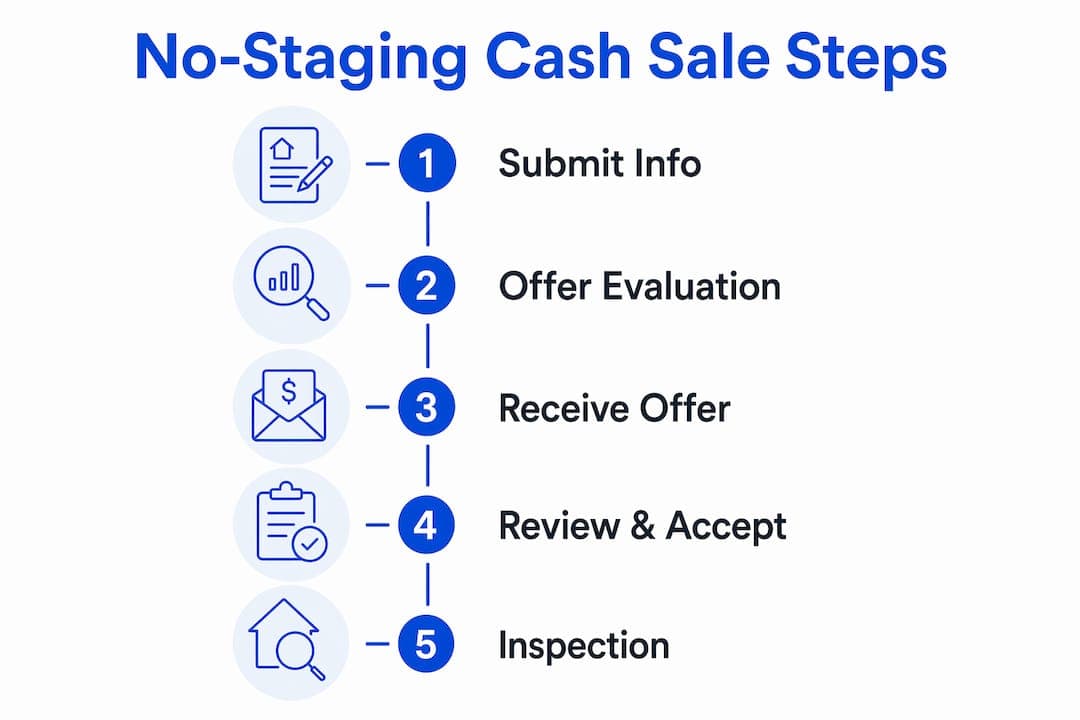
The process is shorter than most sellers expect. From your first inquiry to a check in hand, the typical path looks like this.

Step 1: Submit your home details. You fill out a short form online or call the buyer directly. Basic info, square footage, location, condition, age of major systems, is usually all they need.
Step 2: The buyer evaluates without a showing. Many cash buyers make an initial offer based on your submission alone. Unlike traditional buyers, they are not looking for a staged living room. They are evaluating the property based on its bones and the local market, then factoring repair costs directly into their number.
Step 3: You receive an offer. Offers often arrive quickly, within a couple of days. Some platforms deliver multiple competing bids simultaneously, which gives you real leverage.
Step 4: Review and accept. Read the contract carefully before signing. Confirm there are no hidden fees, financing contingencies, or clauses that let the buyer renegotiate after the fact.

Step 5: Brief inspection (if any). Most cash buyers do a walkthrough, but it is typically a formality to confirm what you described. Because no lender is involved, there is no appraisal requirement and no bank that can kill the deal.
Step 6: Close. You sign the paperwork, and funds transfer. Many cash buyers also cover closing costs entirely for the seller, which can total roughly 9%–10% of the sale price.
Typical timeline milestones:
- Offer received: quickly after submission
- Contract signed shortly after offer
- Walkthrough or inspection occurs soon after
- Closing happens within a matter of weeks from acceptance
Why sellers choose to skip staging and take the cash
Speed is the most obvious reason, but it is not the only one. The financial relief across multiple cost categories adds up fast.
- No staging bill. Professional home staging can be costly depending on home size and market.
- No repair costs. A traditional buyer’s inspection often triggers a repair request list. Cash buyers absorb those costs themselves.
- No agent commission. Standard agent fees are a significant percentage of the sale price and can reduce net proceeds considerably.
- No financing fallout. Financed deals fall apart when buyers lose mortgage approval or when appraisals come in low. Cash deals do not have that problem.
- Fewer showings. You do not spend weeks keeping your home spotless for strangers to walk through.
- Certainty. You know the number, you know the date, and you can plan your next move.
Homeowners facing financial distress, job relocation, divorce, or inherited properties they cannot maintain find this route especially practical. The as-is sale benefits go beyond convenience when time pressure is real.
Pro Tip: Before you submit your home details to any cash buyer, pull together accurate information on your home’s age, roof condition, HVAC age, and any known issues. Buyers who factor repair costs into their initial offer are less likely to renegotiate later, but only if your disclosure is accurate from the start.
What you should know about the downsides
The no-staging cash offer is not a free lunch. The price discount is the most significant drawback, and sellers should go in with clear eyes.
- Below-market offers. Cash buyers price in their renovation costs and profit margin. Investor offers typically come in well below market value.
- Scam risk. Fraudulent “cash buyers” exist. They collect personal information, charge upfront fees, or disappear after signing.
- Unfavorable contract terms. Some contracts include clauses that allow price reductions after inspection or give the buyer extended time to back out.
- No bidding war. With a single offer from a single buyer, you have no competing pressure to push the price up.
- Limited market exposure. You never find out what a fully marketed listing might have fetched.
Key figure: Cash buyers typically offer between 50% and 90% of a home’s fair market value, depending on condition, location, and the buyer’s renovation cost estimates.
The range is wide because condition matters enormously. A move-in-ready home in a strong market might get 85%–90%. A property needing a full gut renovation in a slower market might land closer to 50%. Knowing where your home falls before you accept any offer is the only way to judge whether a bid is fair or predatory.
How to tell if a cash offer is legitimate
Most cash buyers are legitimate businesses. But the ones that are not tend to follow recognizable patterns, and knowing those patterns protects you.
- Demand proof of funds. Any serious buyer can provide a bank statement or letter confirming they have the cash available. No proof means no deal.
- Check for hidden fees. A genuine no-staging, no-upfront-cost offer means you pay nothing before closing. If a buyer asks for an application fee, processing fee, or deposit, walk away.
- Read the contract before signing. Look for clauses that allow price reductions after inspection, extended closing windows with no penalty, or vague language around “additional costs.” The California Attorney General’s office has documented how predatory buyers use contract language to trap distressed sellers.
- Research the buyer’s reputation. Search the company name on the Better Business Bureau at bbb.org and look for verified reviews. A company with no online footprint is a red flag.
- Compare multiple offers. A single offer gives you no baseline. Two or three offers tell you whether the first number was reasonable or a lowball.
- Verify seller rights in your state. The Texas Real Estate Commission publishes a consumer protection notice that outlines seller rights, and most states have equivalent resources.
Pro Tip: Platforms like Housegoodbye.com that generate multiple competing investor bids on your property give you built-in protection against lowball offers. When buyers know they are competing, the numbers tend to reflect actual market conditions more honestly.
Cash offers versus traditional home sales: the real trade-offs
The right choice depends almost entirely on your situation. Here is how the two methods compare across the factors that matter most.
| Factor | No-staging cash offer | Traditional listed sale |
|---|---|---|
| Time to close | much shorter than traditional sales | often several weeks to months |
| Staging and prep costs | none | can be substantial for traditional sales |
| Agent commission | none | typically charged as a percentage of sale price |
| Closing costs (seller) | often covered by buyer | usually paid by seller or split in traditional sales |
| Sale price | generally below full market value | often close to market value |
| Financing fall-through risk | Very low | Common |
| Showings required | — | Multiple |
| Repair requests | None | Frequent after inspection |
The math shifts depending on your home’s condition. If your property needs $40,000 in repairs before it would attract a financed buyer, the gap between a cash offer and a traditional sale narrows considerably. You are not just comparing sale prices; you are comparing net proceeds after all costs.
Traditional sales make more sense when your home is already in good shape, you are not under time pressure, and you have the bandwidth to manage showings, negotiations, and a longer closing process. For sellers who need to sell without staging and cannot absorb months of carrying costs, the cash route often wins on net.
Key figure: Cash buyers typically offer well below market value, while sellers on the traditional market pay closing costs unless covered by the buyer.
How Housegoodbye.com gets you competing cash offers without staging
Housegoodbye.com is built specifically for sellers who want a fast, no-prep sale without leaving money on the table by accepting the first offer they see.
- Multiple competing bids. Housegoodbye submits your property to a network of real estate investors simultaneously. You receive several offers, not one, which creates genuine competition and tends to push prices higher than a single-buyer approach.
- No repairs, no staging, no cleaning. You submit your home’s details as-is. Housegoodbye handles the rest.
- No agent fees. The platform connects you directly with investors, cutting out the traditional commission structure entirely.
- Fast offers. The process is designed to get real numbers in front of you quickly, not preliminary estimates that shift later.
- Closing in as little as 7 days. For sellers facing urgent timelines, whether financial difficulty, relocation, or an inherited property, that speed is the whole point.
- Transparent process. No hidden fees on the seller’s side. What you see in the offer is what you get at closing.
Sellers in Michigan can compare real cash offers through Housegoodbye’s platform, or learn exactly how the cash sale process works before committing to anything.

If you are ready to skip the staging, skip the agent fees, and get a real number on your home fast, Housegoodbye.com is built for exactly that. Sell your house as-is with no repairs required and close on your timeline.
Key Takeaways
Accepting a cash offer with no staging costs means trading some sale price for speed, certainty, and zero upfront expenses, and the net result often favors sellers who are under time or financial pressure.
| Point | Details |
|---|---|
| Price range to expect | Cash buyers typically offer 50%–90% of market value, depending on condition and location. Move-in-ready homes may receive up to 90%, while homes needing significant renovations may be closer to 50%. |
| Closing speed | After accepting a cash offer, closing can happen in as little as 7 days. |
| Cost savings beyond staging | Cash buyers often cover closing costs, which can total 9%–10% of the sale price. |
| Scam protection | Always request proof of funds and compare multiple offers before signing any contract. |
| Best use case | Sellers facing financial distress, relocation, or properties needing major repairs benefit most. |
FAQ
Is getting a cash offer on a house a good idea?
A cash offer is a good idea when speed, certainty, or avoiding repair costs matters more than maximizing sale price. The trade-off is a lower offer, typically in the 50%–90% of market value range, with move-in-ready homes receiving higher offers and homes needing major repairs tending toward the lower end, in exchange for a fast, no-contingency close.
How much less should you expect from a cash offer?
Cash buyers generally offer below market value since they factor in renovation costs and profit margin. The discount varies widely based on your home’s condition and local market, so comparing multiple offers is the only reliable way to gauge fairness.
Is a 10% discount a lowball cash offer?
Not necessarily. A 10% discount on a move-in-ready home in a strong market would be on the low end of reasonable. On a property needing significant repairs, 10% below market could actually be a strong bid once you account for what a traditional buyer would demand in repair credits.
How much stronger is a cash offer compared to a financed one?
Cash offers eliminate the two most common deal-killers in financed sales: appraisal shortfalls and lender approval falling through. That certainty is why sellers often accept a lower cash bid over a higher financed offer, especially in competitive or time-sensitive situations.
Can you negotiate a cash offer even when selling as-is?
Yes. Receiving multiple competing bids is the most effective way to negotiate without making repairs. When investors know others are bidding, they tend to sharpen their numbers. Platforms that generate competing offers, rather than routing you to a single buyer, give you the most leverage.