Selling a house as-is means listing the property in its current condition, with no repairs, renovations, or staging required before closing. For homeowners facing job relocations, foreclosure risk, or financial hardship, understanding how selling as-is saves time is the difference between a controlled exit and a costly delay. A traditional sale takes over three months on average, while an as-is sale to a cash buyer can close in 2–4 weeks. The industry term for this approach is an “as-is sale,” and it is a recognized real estate transaction type with its own pricing norms, disclosure rules, and buyer pool.
How does selling a house as-is speed up the selling process?
The single biggest time drain in a traditional home sale is the repair and preparation phase. Sellers typically spend weeks or months scheduling contractors, waiting on permits, and managing renovation timelines before the home ever hits the market. Skipping that phase entirely is the core mechanism behind the time savings.
An as-is sale removes several other delays as well:
- No staging or deep cleaning required. The home goes to market in its current state, cutting weeks of preparation.
- Fewer buyer contingencies. Cash buyers who specialize in as-is purchases rarely require a traditional home inspection contingency. That removes one of the most common deal-killers in standard transactions.
- No lender appraisal delays. HUD notes that cash transactions bypass multiple lender approval steps, which alone can add 30–45 days to a conventional sale.
- Faster offer timelines. Cash offers for as-is homes often arrive within 24 hours of listing, with closings possible in as few as 7–14 days.
- Simplified paperwork. With no mortgage underwriting on the buyer’s side, the closing document stack shrinks considerably.
The combined effect is dramatic. A traditional sale moves through repairs, listing, showings, offer negotiation, inspection, appraisal, and mortgage underwriting. An as-is cash sale compresses that sequence into listing, offer, and closing.
Pro Tip: Target investors and cash buyer networks directly rather than listing on the MLS alone. Platforms that connect sellers with competing cash buyers, like Housegoodbye, generate multiple offers quickly and let you compare without committing to a single buyer.

The time difference between a typical market sale and an as-is cash sale is not marginal. It is measured in months versus weeks. For a homeowner with a job start date in 30 days or a mortgage payment they cannot make, that gap is everything.
What are the financial trade-offs of selling a house as-is?
The most common objection to an as-is sale is the price discount. As-is properties typically sell for 15%–25% less than comparable move-in-ready homes. That number sounds large until you account for what you avoid paying.
Repair costs alone can range from $5,000 for cosmetic updates to well over $100,000 for structural or mechanical issues. Agent commissions on a traditional sale run 5%–6% of the sale price. And carrying costs during renovation or a prolonged listing period can add $5,000–$15,000 in expenses before you ever close. On a $300,000 home, mortgage, taxes, and insurance alone can total $2,500–$3,000 per month.
The table below shows how the two paths compare on a $300,000 home in fair condition:
| Cost Category | Traditional Sale with Repairs | As-Is Cash Sale |
|---|---|---|
| Repairs and updates | $20,000–$40,000 | $0 |
| Agent commissions | $15,000–$18,000 | $0 |
| Carrying costs (3 months) | $7,500–$9,000 | $0–$3,000 |
| Sale price discount | None | $45,000–$75,000 |
| Net proceeds estimate | $218,000–$258,000 | $222,000–$255,000 |
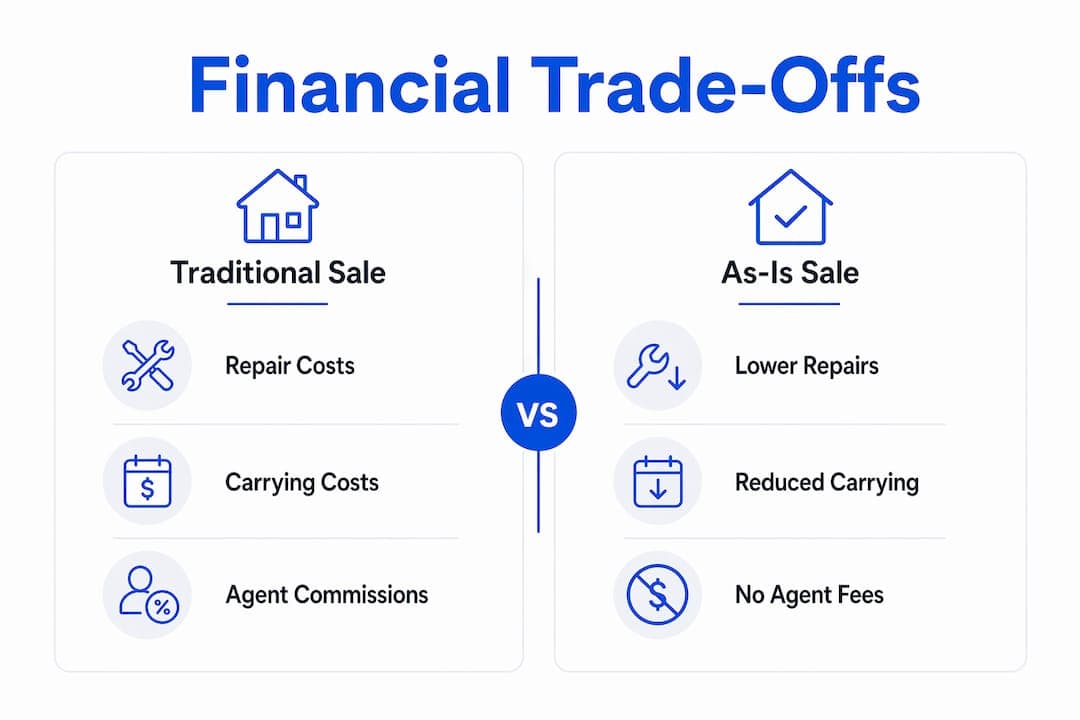
The net difference is often far smaller than homeowners expect. You can use a carrying cost calculator to run the numbers for your specific situation before deciding.
Sellers often misjudge the actual financial loss from an as-is sale. When carrying costs, commissions, and repair bills are factored in, the gap between a renovated sale and an as-is sale narrows significantly. Speed has real dollar value, and every extra month a home sits on the market costs money.
When is selling a house as-is the right call?
Not every homeowner should sell as-is. The decision depends on your timeline, your financial position, and the condition of the property. For certain situations, speed and certainty outweigh a higher sale price every time.
The scenarios where an as-is sale makes the most sense include:
- Urgent relocation or job transfer. When a new employer needs you in another city in 30 days, a three-month traditional sale is not a realistic option.
- Financial hardship or foreclosure risk. Sellers facing foreclosure or serious cash flow problems need a fast, certain close. A drawn-out listing process adds risk, not relief.
- Inherited or estate properties. Heirs often live out of state and have no interest in managing contractors or maintaining a vacant home through a lengthy sale.
- Homes with major structural or mechanical issues. Foundation problems, roof failures, or outdated electrical systems can cost more to fix than the value they add. An as-is sale sidesteps that math entirely.
- Unfavorable market conditions. In a buyer’s market, a home needing work can sit for months. An as-is cash sale removes market exposure risk.
Experts recommend a cost-benefit analysis before committing to either path. Minor cosmetic repairs, like fresh paint or new fixtures, may increase appeal enough to justify the effort. Major structural work rarely returns its full cost in a higher sale price. Knowing which category your home falls into is the first step toward a confident decision. You can review the pros and cons of selling as-is in detail to weigh both sides before moving forward.
What practical steps help you sell a house as-is quickly?
Selling as-is does not mean selling carelessly. A few deliberate steps separate a fast, clean transaction from a deal that drags or falls apart.
- Disclose known issues upfront. Transparent disclosure of known problems reduces renegotiations and builds trust with serious buyers. Experienced investors prefer honesty to surprises at closing.
- Price the home to reflect its condition. An as-is price that ignores repair costs will attract lowball offers and waste time. Research recent sales of comparable distressed properties in your area.
- Target cash buyers and investors directly. List on platforms that reach investors, not just retail buyers. Retail buyers using mortgage financing are far less likely to close on an as-is property without demanding repairs.
- Simplify showings. Offer flexible access, including lockbox showings, to reduce scheduling friction. Serious cash buyers often want to move quickly and will not wait a week for an appointment.
- Work with agents who specialize in as-is sales. A generalist agent may push you toward repairs to protect their commission. An agent experienced with distressed properties knows how to price, market, and close as-is deals efficiently.
- Prepare your paperwork early. Gather your title documents, property tax records, and any existing inspection reports before listing. Having these ready cuts days off the closing timeline.
Pro Tip: Ask any cash buyer for proof of funds before accepting an offer. A legitimate cash buyer can provide a bank statement or letter from a financial institution within 24 hours. This single step filters out time-wasters immediately.
Understanding how much you might lose selling as-is helps you price with confidence and negotiate from a position of knowledge rather than anxiety.
Key Takeaways
Selling a house as-is saves the most time and money when repair costs, carrying costs, and agent commissions would consume most of the gains from a higher sale price.
| Point | Details |
|---|---|
| Timeline advantage | As-is cash sales close in 2–4 weeks vs. 3+ months for traditional listings. |
| Financial gap is smaller than expected | Repairs, commissions, and carrying costs often offset the 15%–25% as-is price discount. |
| Best-fit scenarios | Foreclosure risk, urgent relocation, inherited properties, and major repair needs favor as-is sales. |
| Disclosure builds speed | Upfront honesty about property condition reduces renegotiations and keeps deals on track. |
| Cash buyers are the key | Targeting investors and cash buyer networks directly produces faster offers and fewer contingencies. |
The part most homeowners get wrong about as-is sales
Most homeowners I have worked with come into an as-is sale convinced they are losing money. They fixate on the price discount and ignore the full cost of the alternative. That framing is the single biggest mistake I see.
A traditional sale is not free. It costs time, money, and stress in ways that rarely show up in the headline sale price comparison. Three months of mortgage payments, property taxes, insurance, and utilities on a home you are not living in is a real expense. Add contractor delays, inspection renegotiations, and the emotional weight of managing a sale from a distance, and the picture changes fast.
Selling as-is is not always a financial loss. For many sellers, it is the cost of purchasing time, certainty, and relief from a situation that was already causing harm. That is a legitimate trade, and there is no shame in making it.
The homeowners who regret as-is sales are usually the ones who did not run the numbers first. They accepted a low offer without understanding what a renovated sale would actually net after all costs. The homeowners who feel good about it are the ones who did the math, understood the trade, and made a clear-eyed decision. My advice is simple: calculate your carrying costs, get at least three competing cash offers, and compare the net proceeds honestly. The answer is usually clearer than you expect.
— Bryan
Housegoodbye makes fast as-is sales straightforward
Selling a house quickly without repairs is exactly what Housegoodbye is built for. The platform connects homeowners with multiple competing cash investors, which drives offer prices up and closes the deal faster than a single-buyer approach.

Housegoodbye handles the process from offer to closing, with no agent fees, no repair requirements, and no financing delays. Closing in as little as seven days is standard for motivated sellers. If you are in Michigan and need to move fast, Housegoodbye serves homeowners across the state, including those looking to sell fast in Holland, sell fast in Ann Arbor, and sell fast in Hazel Park. Get your cash offers and see how the process works before you commit to anything.
FAQ
How fast can you close on an as-is home sale?
Cash buyers can close an as-is sale in as few as 7–14 days. That compares to 2–3 months for a traditional financed sale.
Do you have to disclose problems when selling as-is?
Yes. Sellers are legally required to disclose known material defects in most states, even in an as-is sale. Upfront disclosure also reduces renegotiations and keeps the deal moving.
Will you always lose money selling a house as-is?
Not necessarily. When you subtract repair costs, agent commissions of 5%–6%, and carrying costs of $2,500–$3,000 per month, the net proceeds from an as-is sale often come close to a renovated sale.
What type of buyer purchases homes as-is?
Cash investors and real estate investment companies are the primary buyers for as-is properties. They have the capital and experience to purchase without financing or inspection contingencies.
Is selling as-is a good option for inherited properties?
Yes. Inherited properties are one of the strongest use cases for as-is sales. Heirs often live out of state, have no interest in managing repairs, and benefit from a fast, certain close with no ongoing holding costs.