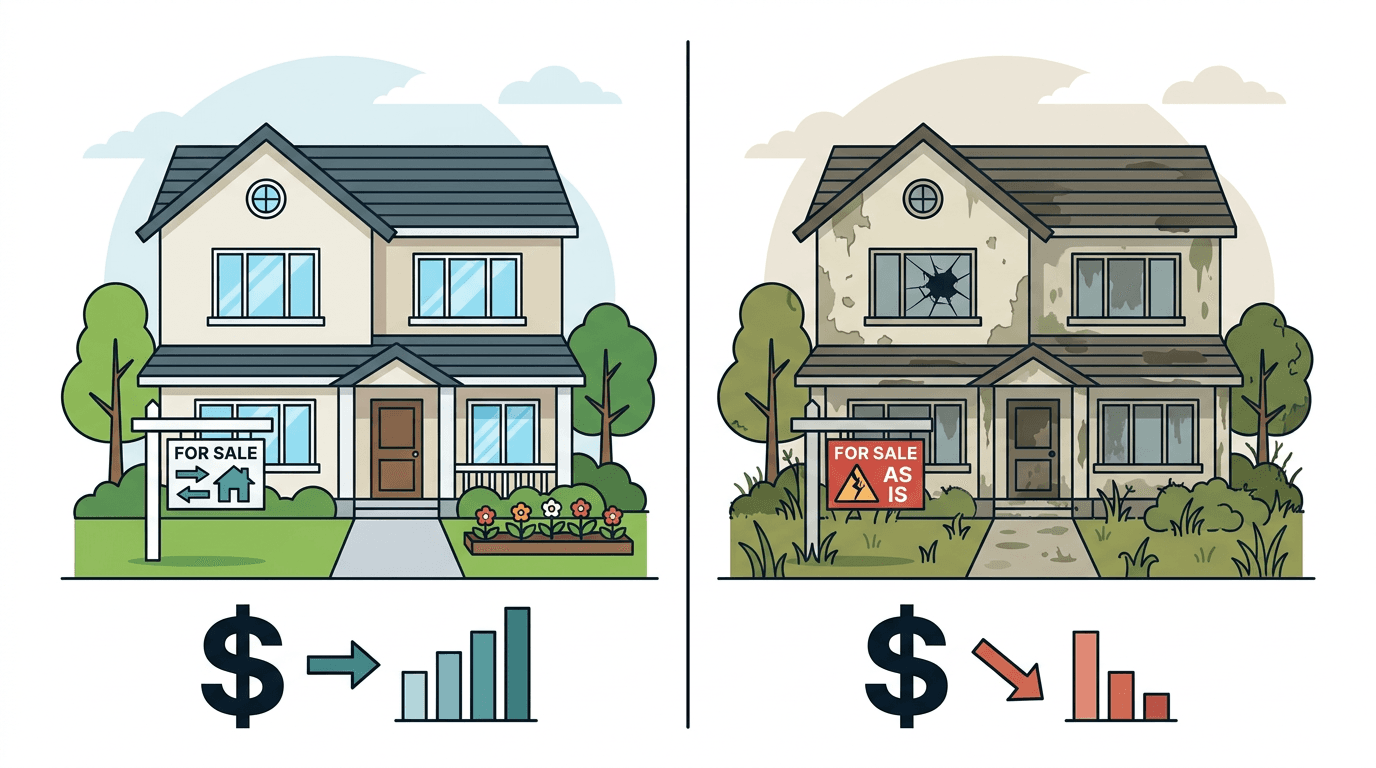
Selling a house as-is means you won't need to make repairs. But it often means sacrificing some profit. How much you lose varies. It depends on your home's condition, where it is, and the current market. This guide helps you understand the costs and benefits of selling your home without fixes.
Key Takeaways:
- Selling "as is" saves you time and money on repairs.
- You will likely get less money, often 5% to 30% below market value.
- The final price depends on your home's condition, location, and market.
- Cash buyers are often the best fit for "as-is" homes.
- You can save on agent fees by selling directly to an "as-is" buyer.
Understanding "As Is" Home Sales
An "as-is" home sale means you sell your house in its current condition. An "as-is" sale means the buyer accepts the home as it stands. You will not make any repairs or updates before the sale. This saves you time and money. Buyers still do their own inspections. However, they cannot ask you to fix anything found. This helps avoid long talks about repairs. You offer the home, and they buy it as is. People choose this option for many reasons. It often provides a fast and easy sale. This is good for people who need to sell quickly due to:- Divorce: Splitting assets quickly can reduce stress.
- Inherited property: Selling an inherited house fast means fewer upkeep costs.
- Moving fast: A new job in another city means you need to move without delay.
- Financial issues: Selling quickly can help with money troubles. The average time to close an "as-is" sale is often 2-4 weeks.
How Much Less Do "As Is" Houses Sell For?
Selling a home "as is" often means accepting a lower price than if you made repairs. When you sell your house "as is," buyers expect a discount. They will need to pay for repairs after closing. This can mean a price drop of 5% to 30% below what a fixed-up home would get. The exact amount depends on how much work your house needs.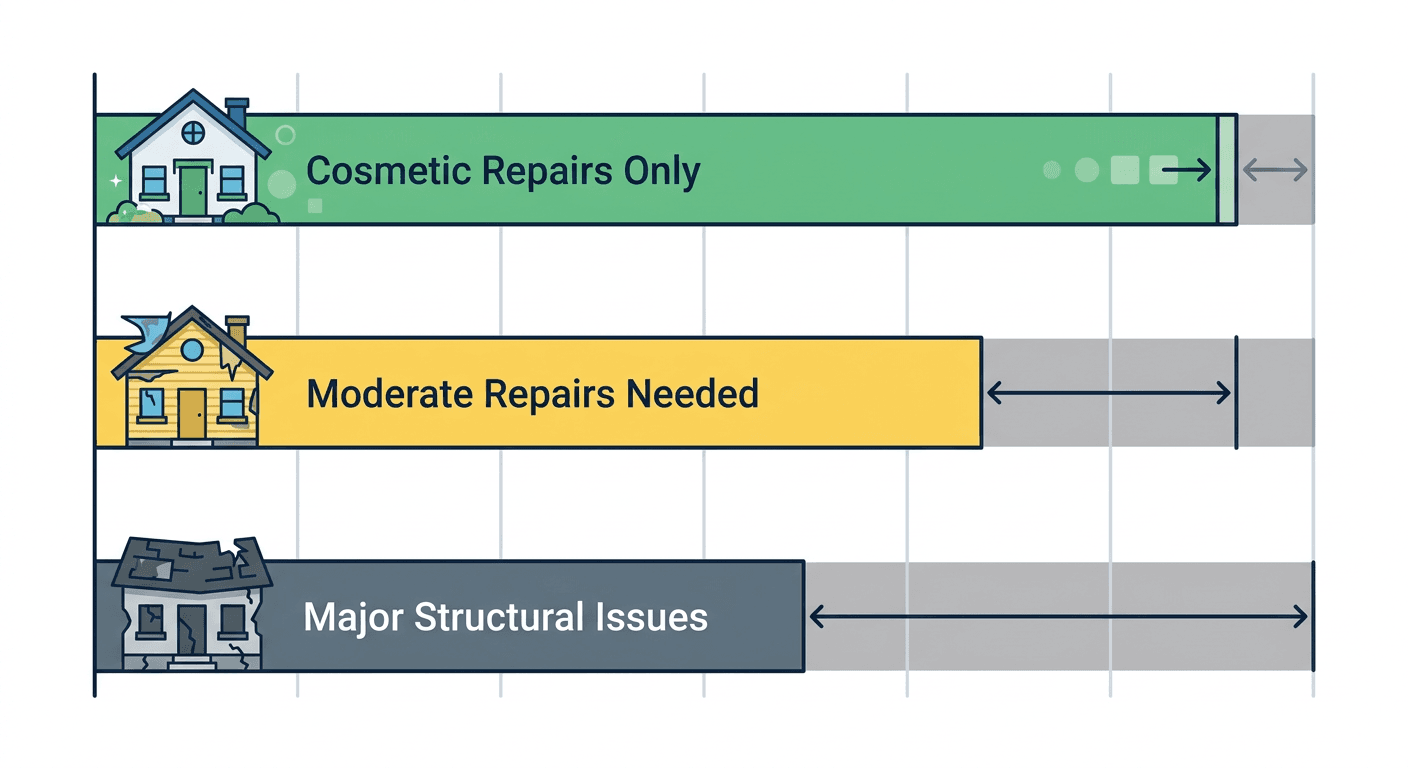
Chart illustrating how much you lose selling a house as is based on repair severity.
For example, imagine your home would sell for $300,000 if it were in perfect shape.
- Minor Fixes (5-10% less): If your house needs fresh paint or new carpet, you might sell it for $270,000 to $285,000. This is a loss of $15,000 to $30,000.
- Moderate Repairs (10-20% less): Problems like a leaky roof or an old furnace could mean a sale price of $240,000 to $270,000. Here, you could lose $30,000 to $60,000.
- Major Issues (20-30%+ less): If your home has big problems, like a cracked foundation or bad electrical wiring, you might sell for $210,000 or even less. This could be a loss of $90,000 or more.
Factors That Impact How Much You Lose Selling a House As Is
Selling your house "as is" means you accept a lower price to save time and effort. When you sell a home "as is," you usually get less money than if it was fully repaired. How much less depends on several key things. We'll look at the main factors that affect your selling price.Property Condition
The biggest factor is your home's condition. Minor issues might not change the price much. Big problems, however, can lead to a much lower offer.- Minor Fixes: Things like fresh paint or new light fixtures are small changes. They might lower your sale price by only 5%.
- Major Repairs: Structural issues (like a sagging foundation) are very costly. So are big problems with the roof or heating and cooling systems. These can cause a home to sell for 20% to 30% less.
- A new roof can cost $10,000 to $20,000.
- Foundation repairs can range from $5,000 to $50,000.
- A new HVAC (heating, ventilation, and air conditioning) system costs $5,000 to $12,000.
Location
Your home's location also plays a big role. In some areas, houses sell quickly even if they need work.- Hot Markets: If your home is in a high-demand city, you might lose less. Buyers fiercely compete. For example, homes in booming areas like Ann Arbor, MI, might attract more buyers ready to renovate. Find out if we buy houses in your area.
- Cold Markets: In areas where homes sit longer, buyers have more choices. They will likely expect a bigger discount for an "as is" property.
Market Conditions
The overall housing market affects your sale price.- Seller's Market: When there are more buyers than homes, sellers have an advantage. You might still get a good price for an "as is" home. Buyers are eager and might overlook small flaws.
- Buyer's Market: When there are more homes than buyers, buyers have the power. They will expect major discounts for homes needing repairs. You could lose more money in this situation.
Type of Buyer
Different buyers look for different things.- Investors: These buyers often look for "as is" homes. They plan to fix them up and sell them for a profit. They typically offer less cash upfront.
- Regular Homebuyers: Most people want a move-in ready home. They will offer less money, or they might not consider an "as is" property at all. This limits your pool of potential buyers.
Is It Good to Sell Your House As Is?
Selling your house "as is" can be a good choice, but it depends on your main goals. This path is great if you want to sell fast and with little stress. It means you will not do any repairs or updates. However, choosing to sell "as is" usually means you will get less money for your house. Most buyers who look at "as-is" homes are investors. They want to buy at a lower price because they plan to do all the needed work. Here are the pros and cons to help you decide: Pros of Selling As Is:- No Repair Costs: You avoid paying for fixes like a new roof or updated kitchen. This saves money upfront.
- Faster Sale: The process moves quicker since you skip repairs and long talks about problems. Many buyers, like those on HouseGoodbye.com, buy homes fast.
- Less Stress: You do not deal with contractors or repair delays. This can be a big relief during busy times.
- Lower Price: You typically sell for less than a house in perfect condition. Homes needing serious repairs can sell for 20% less.
- Smaller Pool of Buyers: Most traditional buyers want a move-in ready home. This leaves fewer people willing to buy your house. Often, only investors are interested.
- Lowball Offers: Because they expect to do work, buyers might offer much less than you hope. You might get offers that are 75% to 95% of your home's fixed-up value.
Selling House As Is vs. Fixing Up: Which is Better?
Choosing to sell your house as-is or fix it up depends on your money, time, and personal situation.
Comparison table outlining the pros and cons of 'Sell As-Is' versus 'Fix Up First'.
Deciding how to sell your home is a big choice. You can sell it "as-is" or spend time and money on repairs. Both ways have pros and cons. We will help you understand them.
Selling your house as-is means you make no repairs before the sale. This saves you stress and time. However, you will likely get a lower price for your home. Buyers expect a discount when they have to do work themselves.
Fixing up your house means you spend money and effort on repairs. This can bring a higher sale price. For example, a minor kitchen remodel often returns about 70% of its cost (source: Remodeling Magazine Cost vs. Value Report). A bathroom remodel might return 60%. These repairs can make your house more attractive. This means it might sell faster for more money.
Here's a quick look at the two options:
Consider your personal situation. Do you need to sell your house fast? Do you have extra cash for repairs? If you have inherited a house, you might not want the burden of repairs. Someone downsizing might prefer a quick sale.
Think about common fixes that can increase value. These include updating kitchens or bathrooms. Fresh paint and new flooring also make a big difference. But remember, fixes cost money and time. If you don't have these, selling as-is can be the smarter choice. Our team helps people sell houses in any condition every day.
| Feature | Sell As-Is | Fix Up First |
|---|---|---|
| Effort | Very Low (no repairs or cleaning beyond basic) | High (managing contractors, choosing materials) |
| Time to Sell | Fast (appeals to investors looking for deals) | Potentially Slower (repairs take time, then sale) |
| Sale Price | Lower than market value | Higher, closer to market value |
| Costs Upfront | Very Low (only basic selling costs) | High (repair costs, staging, real estate agent fees) |
| Buyer Type | Investors, cash buyers | Standard home buyers searching for move-in ready homes |
What is the 3-3-3 Rule in Real Estate?
The "3-3-3 rule" is a guideline that helps homeowners get ready to sell. This rule suggests you focus on three main areas. It helps you prioritize your time and money. It is not an official real estate rule, but more like a helpful tip. The "3-3-3 rule" means:- Three areas to focus on: Make your home presentable, price it right, and promote it well.
- Three key decisions: Decide what to fix, how to price, and how to market.
- Three goals for buyers: Attract buyers, get good offers, and close the sale.
Can You Sell a House As-Is Without Inspection?
Even when selling your house "as-is," buyers often still have the option to get an inspection. Selling a house "as-is" does not remove your legal need to disclose known problems. You must tell potential buyers about any major defects you are aware of. This protects you from future legal issues. Even with an "as-is" sale, buyers can still ask for their own inspections. Many buyers want to know the true condition of the home. This helps them decide if the offered price is fair. An "as-is" clause in a contract means the buyer accepts the home in its current state. They agree not to ask you for repairs or credits after their inspection. This speeds up the sale process. However, buyers can still walk away if the inspection uncovers major issues. This often happens if the problems are too costly to fix. In competitive markets, some cash buyers waive inspections to make their offers stronger. This helps them close faster. Selling your house quickly and stress-free is possible. HouseGoodbye.com connects you with buyers who compete for your home, even if it needs work.State-Specific Considerations for As-Is Sales
It's important to know that selling "as is" can be different depending on where your house is located. Disclosure (telling the buyer about problems) laws change by state. What you must tell a buyer about your home's condition in California might be different from Texas. For example, some states have special forms you must fill out. This helps buyers understand what they are purchasing. Understanding your local rules is very important. It helps make your "as is" sale go smoothly. Always talk to a local real estate expert for advice on your state's laws. This ensures you follow all rules and avoid issues. To learn more about selling your house fast in specific areas, check out our guides for selling a house fast in Holland, MI or selling a house fast in Allen Park, MI.Finding the Right Buyer for Your As-Is Home
Getting the right buyer for your as-is home means knowing your options and what each offers. When you sell a house as-is, certain buyers are a better fit. These buyers often look for homes they can fix up. They see value in properties others might pass over.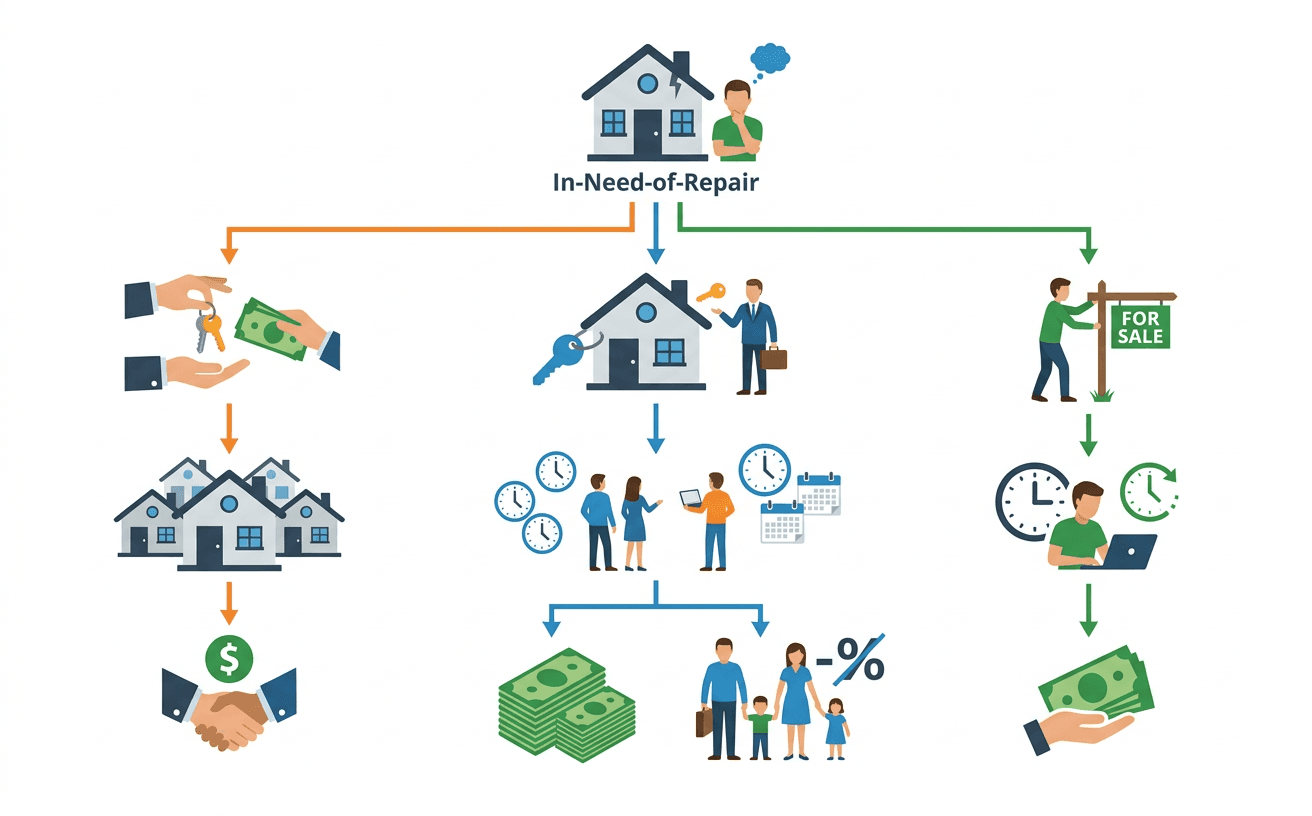
Flowchart illustrating different ways to sell an 'as-is' home and their outcomes.
Three main types of buyers exist for as-is homes:
- Cash Home Buyers: These companies, like HouseGoodbye.com, offer quick cash. They buy homes fast and handle repairs themselves. This means you do not pay for fixes or wait for loans. You get a firm offer and close quickly.
- Real Estate Investors: These individuals or groups also buy distressed properties. They often pay cash and aim to renovate and resell. They can be a good option for speed and convenience.
- Traditional Buyers: These buyers work with a real estate agent. They look for homes to live in. Selling as-is to them often means fewer offers and a lower price. General buyers may also ask for many repairs, even in an as-is sale. This can cause delays during the process.
How Much Does a Real Estate Agent Make on a $300,000 Sale?
Knowing real estate agent fees helps you plan your home sale budget well. When you sell your house, you usually pay a real estate agent. Their fee is called a commission. This fee is a part of the final sale price. Average commission rates are often between 5% and 6% of the home's price. For a house sold at $300,000, here is what this looks like:- 5% commission: $15,000
- ($300,000 x 0.05 = $15,000)
- 6% commission: $18,000
- ($300,000 x 0.06 = $18,000)