
TL;DR:
- Selling to cash house buyers offers speed and certainty but often results in lower net proceeds. Verifying proof of funds and the escrow company is essential to avoid scams, and comparing multiple offers helps secure the best deal. The process is most beneficial for urgent situations like foreclosure, inherited properties, or major repairs needed.
Selling to cash house buyers works — but only if you go in knowing the tradeoff. You will likely net less than a full market-value listing, but you can close very quickly, skip repairs entirely, and avoid the uncertainty of a buyer whose mortgage falls through. The smartest move before signing anything: get competing offers from multiple buyers and ask every one of them for written proof of funds. Cash sales represent a significant portion of all transactions, indicating the market for this is real and active. Two things to verify immediately: confirmed proof of funds (a bank letter, not a screenshot) and a named title or escrow company handling the closing. If a buyer balks at either, walk away.
Table of Contents
- How do cash house buyers work, and what types are out there?
- Which homeowners benefit most from selling for cash?
- What price, costs, and timeline should you realistically expect?
- How do you evaluate and verify a cash offer before signing?
- Step-by-step: what happens from first contact to closing?
- How Housegoodbye’s bidding marketplace gets you better offers
- What legal disclosures do you need to make when selling for cash?
- What are the tax implications of a cash home sale?
- Key Takeaways
- What sellers often get wrong about the cash offer process
- Get competing cash offers for your Michigan home through Housegoodbye
- Authoritative sources and further reading
- FAQ
How do cash house buyers work, and what types are out there?
Not all cash buyers operate the same way, and that difference directly affects what you get paid and how fast you close.
Individual buyers pay with personal savings and typically make competitive offers close to market value, but they are rare for distressed or as-is properties. Private investors and flippers are the most common type. They use a pricing formula called the 70% ARV rule: they will pay no more than 70% of the property’s after-repair value, minus estimated repair costs. That math protects their profit margin, which means your offer will reflect it. Wholesalers do not buy your home at all. They put it under contract at a low price, then assign that contract to an end investor for a fee. If they cannot find a buyer, they may back out. iBuyers use algorithmic pricing and typically offer closer to market value, but they charge service fees and operate in select markets.
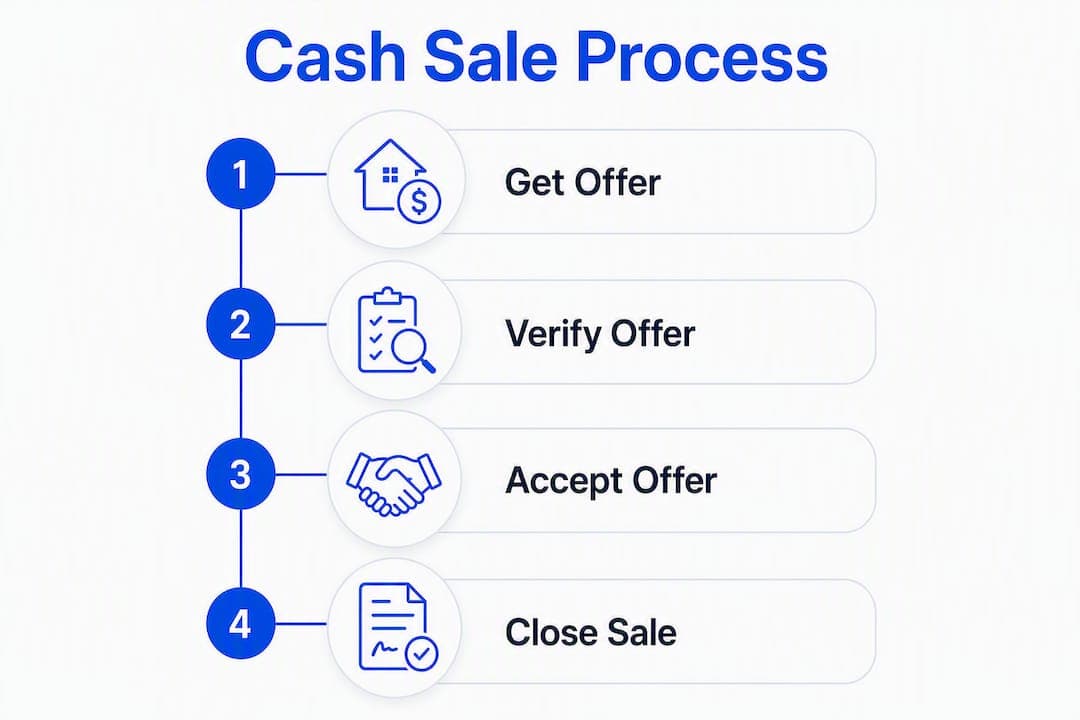
The basic flow of a cash purchase looks like this:
- You submit property details and receive an initial offer.
- You verify the buyer’s proof of funds and confirm escrow involvement.
- Both parties sign a purchase agreement (inspect optional, often waived).
- Title work runs in parallel; escrow holds the funds.
- Closing happens; funds transfer and keys change hands.
“The certainty of a cash close is often worth more to a seller than the price difference. No mortgage underwriting means no last-minute fall-through — and that peace of mind has real financial value, a concept well explained in our mortgage deal comparison.” — Zillow
Which homeowners benefit most from selling for cash?
A cash sale is not the right call for everyone. It makes the most sense when speed, certainty, or property condition matters more than squeezing out the last dollar.
Situations where cash buyers are often the best fit:
- Foreclosure or pre-foreclosure: A fast close can stop the process and protect your credit.
- Inherited property: Especially when heirs live out of state or the home needs significant work before it could list.
- Urgent relocation: Job transfer, divorce, or a family emergency where a 60-day listing timeline is not realistic.
- Major repairs needed: Roof damage, foundation issues, or outdated systems that would cost tens of thousands to fix before listing. Selling as-is to a cash buyer sidesteps all of it.
- Hoarder or heavily cluttered properties: Buyers who specialize in distressed homes buy without requiring cleanout.
- Tight cash timeline: When you need equity from the sale to fund a purchase or cover a debt.
If you have a strong local market, time to prep and stage, and no urgent deadline, a traditional listing will almost always net you more. The math usually favors listing when you can afford to wait.
Pro Tip: When negotiating with a cash buyer, do not focus only on price. Ask about a short-term leaseback (staying in the home for 30–60 days after closing), inclusion of appliances, and your preferred closing date. These terms cost the buyer little but can be worth thousands to you — and most sellers never think to ask.
What price, costs, and timeline should you realistically expect?
Timeline: Cash offers can shorten closing from the typical 30–45 days of a financed sale to as little as 7–10 days. In practice, most cash deals close in 7–21 days. What speeds things up: a clear title, no liens, and a buyer who has funds ready. What slows them down: title issues, probate complications, or a wholesaler still searching for an end buyer.

Price: Expect offers in the range of 50%–80% of fair market value, depending on the buyer type and your property’s condition. Flippers applying the 70% ARV rule will land at the lower end after subtracting repair estimates. iBuyers typically offer closer to market but add service fees. The headline number is not the whole story, though.
Here is where the net-proceeds math gets interesting:
- No agent commissions: Traditional sales typically cost 5%–6% in agent fees.
- No repair costs: Cash buyers buy as-is, so you skip pre-listing repairs that can run $10,000–$50,000 or more.
- No staging or holding costs: No mortgage payments, utilities, or insurance during a long listing period.
- Closing costs: Confirm who pays — some buyers cover all closing costs, others split them.
When you subtract those avoided costs from a traditional sale’s gross price, the net gap between cash and market often narrows considerably. Run the actual numbers before assuming a cash offer is a bad deal.
Statistic: Cash sales close faster on average than traditional financed sales, according to industry data.
How do you evaluate and verify a cash offer before signing?
The first conversation with any buyer should answer five questions: What type of buyer are you? Can you provide written proof of funds? Who is the title or escrow agent? What is your proposed closing date? And who pays closing costs?
Red flags that should stop you cold:
- Buyer asks for an upfront fee before making an offer.
- Buyer refuses to name a title or escrow company.
- Proof of funds is a screenshot, a letter with no bank contact info, or a vague “line of credit” reference.
- High-pressure tactics to sign within 24–48 hours with no time to review.
- Purchase contract includes an open-ended assignment clause with no named end buyer.
That last one is the wholesaler trap. If the contract can be assigned to an unnamed third party, you have no idea who will actually close — or whether anyone will.
Proof-of-funds request template (copy and send): “Before we proceed, please provide a bank letter or official statement on letterhead confirming available funds of at least [purchase price], dated within the last 30 days. Please also provide the name and contact information for the title or escrow company you plan to use.”
Pro Tip: Call the bank directly using the number on the institution’s official website — not the number printed on the letter the buyer sends you. Fraudulent proof-of-funds letters exist, and a 60-second phone call is all it takes to confirm the document is real.
Learning how multiple cash offers work before you start talking to buyers puts you in a much stronger position.

Step-by-step: what happens from first contact to closing?
Here is the practical sequence, with typical timing for each stage.
| Step | What Happens | Typical Timeframe |
|---|---|---|
| 1. Submit property details | Share address, condition, and timeline with buyer or marketplace | Day 1 |
| 2. Receive and review offers | Buyer inspects (optional) and delivers written offer | Days 1–3 |
| 3. Verify buyer and funds | Request proof of funds; confirm escrow agent | Days 2–4 |
| 4. Sign purchase agreement | Review and sign; confirm assignment clause terms | Days 3–5 |
| 5. Title search and escrow | Title company clears liens; escrow holds funds | Days 4–10 |
| 6. Closing and funds transfer | Sign settlement statement; receive wire transfer | Days 7–21 |
Steps 3 through 5 can run in parallel, which is how experienced buyers compress the timeline. Documents you will see: the purchase agreement, your state-required seller disclosures, a title commitment, and a settlement statement (HUD-1 or ALTA).
- Submit property details to one or more buyers or a marketplace platform.
- Verify the buyer using the proof-of-funds template above before going further.
- Sign the purchase agreement only after reviewing assignment clauses and closing cost terms.
- Let the title company work. A licensed title or escrow agent protects both parties and confirms clear ownership.
- Close and collect funds via wire transfer or certified check on the agreed date.
How Housegoodbye’s bidding marketplace gets you better offers
Most sellers contact a single cash buyer, get one offer, and have no way to know if it is fair. Housegoodbye solves that by sending your property details to a network of vetted local investors in Michigan who compete for your listing. Competition changes the dynamic entirely.
“When multiple investors bid on the same property, sellers gain leverage they simply do not have with a single take-it-or-leave-it offer. That competition is the mechanism that closes the gap between cash and market value.” — Bankrate
Here is how the Housegoodbye marketplace compares to going directly to a single buyer:
| Feature | Single Cash Buyer | Housegoodbye Marketplace |
|---|---|---|
| Number of offers | One | Multiple competing bids |
| Investor vetting | You verify independently | Pre-vetted local investors |
| Proof of funds | You must request | Part of the process |
| Escrow/title use | Varies by buyer | Standard practice |
| Agent commissions | None | None |
| Repair requirements | Varies | None — buy as-is |
| Closing timeline | 7–21 days | As little as 7 days |
No repairs. No agent fees. No obligation to accept any offer. Sellers in Michigan can also use Housegoodbye’s estate property resources when dealing with inherited homes.
Pro Tip: When you receive competing bids through a marketplace, use the highest offer as leverage with your preferred buyer. Many investors will improve their price or terms when they know another bid is on the table — but only if you tell them.
What legal disclosures do you need to make when selling for cash?
Selling for cash does not exempt you from disclosure requirements. Every state has its own rules, but federal law and most state statutes require sellers to disclose known material defects regardless of whether the sale is as-is or cash.
Common required disclosures include: known structural defects, roof condition, water damage or flooding history, presence of lead paint (federal law for homes built before 1978), mold, pest infestations, and any legal issues affecting the title. “As-is” in a purchase contract means the buyer accepts the property in its current condition — it does not mean you can hide known problems. Concealing a material defect can expose you to legal liability after closing.
A licensed title company or real estate attorney can walk you through your state’s specific disclosure form. In Michigan, sellers use the Seller’s Disclosure Statement, which covers structural, mechanical, and environmental conditions. Completing it honestly is both a legal requirement and your protection if a dispute arises later.
What are the tax implications of a cash home sale?
The IRS treats a cash sale the same as any other home sale for tax purposes. The key figure is your capital gain: the difference between your sale price and your adjusted cost basis (what you paid, plus qualifying improvements).
If you have owned and lived in the home as your primary residence for at least two of the five years before the sale, you may exclude up to $250,000 of gain from federal income tax ($500,000 for married couples filing jointly), under IRS Section 121. Gains above those thresholds are taxed at long-term capital gains rates (0%, 15%, or 20%, depending on your income) if you held the property for more than a year.
For inherited properties, the cost basis typically steps up to the fair market value at the date of the original owner’s death, which often reduces or eliminates capital gains tax. Investment properties do not qualify for the Section 121 exclusion and may also trigger depreciation recapture. Consult a tax professional for your specific situation, since state income taxes on home sale gains vary by state.
This article is general information, not tax or legal advice. Confirm current rules with the IRS, your state tax authority, or a qualified professional before making decisions.
Key Takeaways
Selling to cash buyers is a legitimate, fast option — but comparing multiple verified bids is what separates a fair deal from a bad one.
| Point | Details |
|---|---|
| Speed vs. price tradeoff | Cash sales close in 7–21 days but typically offer 50%–80% of market value. |
| Net proceeds math | Avoided agent fees, repairs, and holding costs often narrow the gap with a traditional sale. |
| Verification is non-negotiable | Always request written proof of funds and confirm a named escrow or title company before signing. |
| Wholesaler risk | Open-ended assignment clauses mean the person you signed with may never close — ask who the end buyer is. |
| Housegoodbye marketplace | Michigan homeowners can request competing bids from vetted local investors, with no repairs, no agent fees, and closings in as little as 7 days. |
What sellers often get wrong about the cash offer process
The conventional wisdom says cash offers are for desperate sellers. That framing is outdated and costs people money.
The sellers who do best in cash transactions are the ones who treat it like any negotiation: they come in with information, they get multiple bids, and they use competition to improve terms. The sellers who get burned are the ones who call one buyer, feel relieved when an offer arrives, and sign before asking a single verification question.
Price is also not the only lever. A seller who negotiates a 45-day leaseback after closing, gets the buyer to cover all closing costs, and avoids $15,000 in pre-listing repairs may net more than a seller who listed traditionally, paid two agents, and sat on the market for 90 days. The math is rarely as simple as “cash offer vs. list price.”
One realistic expectation: even with competing bids, you are unlikely to match what a well-prepared traditional listing would fetch in a strong market. Cash buyers price in their risk and their margin. That is not a scam — it is their business model. Knowing that going in lets you make a clear-eyed decision instead of feeling shortchanged after the fact.
Get competing cash offers for your Michigan home through Housegoodbye
If you have read this far, you already know the single biggest mistake sellers make: accepting the first offer without knowing what else is out there.

Housegoodbye connects Michigan homeowners with multiple vetted local investors who compete for your property, as-is, with no repairs, no agent commissions, and no obligation to accept any offer. Submit your property details and you can have competing bids in hand quickly, with closings available in as little as 7 days. Every investor in the network goes through a vetting process, and escrow protection is standard.
Whether you are in Holland, Warren, or anywhere else in Michigan, the process is the same: share your property details, review your offers, pick the best one, and close on your timeline.
Request your competing cash offers through Housegoodbye today and see what Michigan investors will pay for your home.
Authoritative sources and further reading
- Bankrate: Cash Homebuyer Companies — Explains buyer types (investors, wholesalers, iBuyers) and how their pricing models differ; useful for comparing offer structures.
- Zillow: Should I Accept a Cash Offer? — Covers proof-of-funds verification, closing timelines, and the fall-through risk advantage of cash sales.
- CNBC Select: We Buy Houses Companies Explained — Details wholesaler assignment clauses and the 70% ARV rule flippers use to price offers.
- FinanceBuzz: Is Selling for Cash a Smart Move? — Breaks down as-is savings and how avoided repair and staging costs affect net proceeds.
- SellWithDealMate: Pros and Cons of Selling for Cash — Provides transaction share data and a side-by-side timeline comparison of cash vs. traditional sales.
- Better Business Bureau — Use to check ratings and complaint history for any cash buyer company before signing.
FAQ
How much will a cash buyer typically pay for a house?
Most cash buyers offer 50%–80% of fair market value, depending on buyer type and property condition. Flippers applying the 70% ARV rule land at the lower end; iBuyers tend to offer more but charge service fees.
Is selling your house for cash a good idea?
It depends on your priorities. If speed, certainty, and avoiding repairs matter more than maximizing sale price, a cash sale is a strong option. Sellers with time to list traditionally in a healthy market will usually net more.
Who is the best cash buyer for your home?
No single buyer is universally best. Comparing multiple bids from vetted investors is the most reliable way to find the strongest offer. Housegoodbye’s marketplace does this automatically for Michigan homeowners.
How fast can a cash sale actually close?
Cash offers can close in as little as 7–10 days when title is clear and funds are ready. Most deals land in the 7–21 day range; title issues or probate complications are the most common causes of delay.
What should you verify before accepting a cash offer?
Request written proof of funds on bank letterhead dated within 30 days, and confirm the name of the title or escrow company the buyer plans to use. If a buyer refuses either, treat it as a red flag and do not sign.